Terracotta
“Earth shaped by 5000-year-old hands.”
The Story
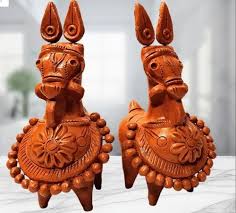
India's terracotta tradition dates to the Indus Valley civilisation. Terracotta is one of the world's oldest and most enduring craft traditions, with a history dating back over 5,000 years. Derived from the Italian words "Terra" (earth) and "Cotta" (baked), Terracotta literally means "baked earth." The craft involves shaping natural clay and firing it at high temperatures to create durable pottery, sculptures, decorative objects, and architectural elements. In India, Terracotta has been practiced since the Indus Valley Civilization (2500 BCE), where archaeologists discovered terracotta figurines, toys, pottery, and ritual objects. Over centuries, the craft evolved across different regions, becoming an integral part of religious, cultural, and everyday life. Terracotta artisans traditionally created idols, horses, elephants, lamps, utensils, wall panels, and decorative items inspired by local traditions and folklore. Different states developed unique styles, including the famous Bankura Horses of West Bengal, Molela plaques of Rajasthan, Bastar terracotta of Chhattisgarh, and traditional pottery clusters across India. Today, Terracotta remains one of India's most significant handicraft traditions, blending ancient techniques with contemporary design to create sustainable home décor, garden products, sculptures, tableware, and lifestyle accessories.
The Technique
Local clay is hand-thrown on a wheel or hand-modelled, sun-dried, then fired in open kilns at 800-900°C. Terracotta is created through a traditional process of clay preparation, shaping, drying, firing, and finishing. Artisans first collect and refine natural clay by removing impurities and mixing it with water to achieve the desired consistency. The clay is then shaped by hand, moulded, or formed on a potter's wheel into various products such as figurines, pottery, lamps, and decorative objects. After shaping, the pieces are dried naturally in the sun to remove moisture. Once completely dry, they are fired in a kiln or traditional furnace at high temperatures, which hardens the clay and gives Terracotta its characteristic reddish-brown color. Depending on the product, artisans may further decorate, carve, paint, polish, or glaze the surface. The entire process is handmade and requires skill, patience, and generations of traditional knowledge, making each Terracotta creation unique.
Traditional Motifs
Shop Terracotta Products
New Terracotta products are coming soon.