Madhubani
“The painted poetry of Mithila women.”
The Story
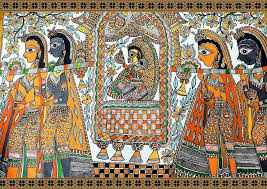
Originating in the Mithila region of Bihar over 2500 years ago, Madhubani painting was traditionally done by women on the mud walls of their homes during festivals and weddings. The art form gained global recognition in the 1960s.
The Technique
Painted with twigs, matchsticks and fingers using natural pigments — turmeric for yellow, indigo for blue, sandalwood for red. Madhubani Painting is created through a detailed hand-painting process that uses fine lines, intricate patterns, and vibrant colors to depict stories from mythology, nature, daily life, and cultural traditions. Artists begin by sketching the design freehand on paper, canvas, fabric, or walls using bamboo pens, nib pens, or brushes. The outlines are then filled with elaborate geometric patterns, floral motifs, animals, birds, and symbolic elements. Traditionally, natural colors derived from turmeric, indigo, flowers, leaves, soot, and minerals were used, though many artists now also use acrylic and poster colors. One of the distinctive features of Madhubani art is that empty spaces are rarely left blank; they are filled with fine lines, dots, and decorative patterns to create a rich visual composition. The entire process is done by hand, requiring precision, creativity, and generations of artistic knowledge, making each Madhubani artwork unique and deeply rooted in the cultural heritage of Mithila.